[Sitemap] [Contact] [Imprint] Deutsche Version Search site 

Plutonium, Pu, Element 94


Plutonium

Plutonium - chemical symbol Pu, atomic number 94 - is a silvery, yellow tarnish when oxidized, toxic, radioactive, in six allotropes occuring, chemical element in the group of actinides (transuranium element).

Online available information resources about the chemistry and physics of plutonium and the plutonium compounds.

Further information categories about related topics are listed in the navigation menu on the left side of these page.


[Ele] [Atom] [Phy] [Special] [Hist] [Group] [Reac] [Syn] [Environ] [Tox] [Jour] [Diss] [Research] [Org]

 |

Information and data about the element


Plutonium, Pu
Chemical and physical properties. Webelements, UK - [e]

Plutonium, Pu
Chemical and physical properties; comprehensive data. Environmental Chemistry, USA - [e]

Plutonium, Pu
Chemical and physical properties of plutonium. Visual Elements, Chemsoc, UK - [e]


[Ele] [Atom] [Phy] [Special] [Hist] [Group] [Reac] [Syn] [Environ] [Tox] [Jour] [Diss] [Research] [Org]

 |

Atom, Orbitals, Radiochemistry


Atomic Data for Plutonium (Pu)
Basic Atomic Spectroscopic Data. NIST, USA - [e]

Isotopes of Plutonium
Berkeley National Laboratory - [e]

Radiochemistry of Plutonium
Nuclear Science Series: Monographs on Radiochemistry and Radiochemical Techniques. National Academy of Sciences. LANL, USA - [e]

Radiochemistry of Uranium, Neptunium and Plutonium
Some procedures used in the radiochemical, isolation, purification and/or analysis of uranium, neptunium and plutonium. LANL, USA - Format: PDF - [e]


[Ele] [Atom] [Phy] [Special] [Hist] [Group] [Reac] [Syn] [Environ] [Tox] [Jour] [Diss] [Research] [Org]

 |

Physics and physical data


X-ray properties of Plutonium
Periodic table of X-ray properties. CSRRI, USA - [e]

a-Energies in Energy-Order of Actinides
Isotopes included: Am-239, -241, -243; Cf-248, -252; Cm-240, -241, -242, -243, -244; Np-237; Pu-236, -238, -239, -240, -241, -242, -244; U-232, -233, -236 - Format: PDF - [e]


[Ele] [Atom] [Phy] [Special] [Hist] [Group] [Reac] [Syn] [Environ] [Tox] [Jour] [Diss] [Research] [Org]

 |

Special Information


Surface and Corrosion Chemistry of Plutonium
Scientific article. FAS, USA - Format: PDF - [e]


[Ele] [Atom] [Phy] [Special] [Hist] [Group] [Reac] [Syn] [Environ] [Tox] [Jour] [Diss] [Research] [Org]

 |

Historical Facts and Documents


The Discovery and Isolation of Plutonium
History of plutonium - [e]


[Ele] [Atom] [Phy] [Special] [Hist] [Group] [Reac] [Syn] [Environ] [Tox] [Jour] [Diss] [Research] [Org]

 |

Group Elements - Information


Actinides
Uncovering the Secrets of Actinides: illustrated article, covering the uses of these elements in nuclear chemistry, and related research initiatives - [e]

Actinides and the Sources of Cosmic Rays
Scientific article. MPG, Germany - Format: PDF - [e]

Actinides(III)-Lanthanides Group Separation from Nitric Acid
In this paper, extractants are presented which made it possible to separate actinides(III) and lanthanides from strong nitric acid solutions - Format: PDF - [e]

Lanthanides and Actinides
General Information. Radiochemistry Society, USA - [e]

Lanthanides and Actinides
Some general points important for quantum chemical studies of systems containing lanthanides and actinides, then briefly summarizes the quantum chemical methods applied so far to study f element systems, and finally focusses on a few characteristic examples. Wiley - Format: PDF - [e]

Lanthanides and Actinides
Lecture notes in Inorganic Chemistry. S. J. Heyes, Oxford, UK - [e]

Metallofullerenes Encapsulating Actinides
Study of Metallofullerenes Encapsulating Actinides - Format: PDF - [e]

Structures of the Lanthanides, Actinides, and Their Compounds
Crystal Lattice Structures. US Gov - [e]

The Chemical Interactions of Actinides in the Environment
PDF article, FAS (USA) [e]. FAS, USA - Format: PDF - [e]

Transuranium Elements
A short introduction - [e]


[Ele] [Atom] [Phy] [Special] [Hist] [Group] [Reac] [Syn] [Environ] [Tox] [Jour] [Diss] [Research] [Org]

 |

Chemical Reactions


Tetravalent plutonium
Chemistry of tetravalent plutonium and zirconium. Hydrolysis, solubility, colloid formation and redox reactions. Dissertation, 2006. University of Heidelberg - [e]


[Ele] [Atom] [Phy] [Special] [Hist] [Group] [Reac] [Syn] [Environ] [Tox] [Jour] [Diss] [Research] [Org]

 |

Synthesis, production


Actinide Resin
Group actinide separations/gross alpha measurements - technical info. Eichrom, USA - [e]

Extraction Chromatography of actinides and Selected Fission Products
Principles and Achievement of Selectivity. Eichrom - [e]


[Ele] [Atom] [Phy] [Special] [Hist] [Group] [Reac] [Syn] [Environ] [Tox] [Jour] [Diss] [Research] [Org]

 |

Environmental Chemistry


Siderophore-Mediated Chemistry and Microbial Uptake of Plutonium
Scientific article. FAS - Format: PDF - [e]

The Environmental Transport of Radium and Plutonium
A Review, 2006. Institute for Energy and Environmental Research, USA - Format: PDF - [e]


[Ele] [Atom] [Phy] [Special] [Hist] [Group] [Reac] [Syn] [Environ] [Tox] [Jour] [Diss] [Research] [Org]

 |

Toxicology and Medicinal Chemistry


ToxFAQs™ for Plutonium
This fact sheet answers the most frequently asked health questions about plutonium. ATSDR, USA - [e]

Toxicological Profile for Plutonium
The ATSDR toxicological profile succinctly characterizes the toxicologic and adverse health effects information for the hazardous substance described there - [e]


[Ele] [Atom] [Phy] [Special] [Hist] [Group] [Reac] [Syn] [Environ] [Tox] [Jour] [Diss] [Research] [Org]

 |

Journals


Journal of Nuclear Materials
... publishes high quality papers in materials research relevant to nuclear fission and fusion reactors and high power accelerator technologies, and in closely related aspects of materials science and engineering. Elsevier - [e]

Journal of Radioanalytical and Nuclear Chemistry
An International Journal Dealing with All Aspects and Applications of Nuclear Chemistry. Springer - [e]

Radiation Physics and Chemistry
... is a multidisciplinary journal that provides a medium for publication of substantial and original papers, reviews, and technical notes. Elsevier - [e]


[Ele] [Atom] [Phy] [Special] [Hist] [Group] [Reac] [Syn] [Environ] [Tox] [Jour] [Diss] [Research] [Org]

 |

Dissertations


Pseudopotentials
Relativistic Energy-consistent Pseudopotentials for f-Elements. Dissertation, 2010. University of Cologne - [e]


[Ele] [Atom] [Phy] [Special] [Hist] [Group] [Reac] [Syn] [Environ] [Tox] [Jour] [Diss] [Research] [Org]

 |

Research facilities and departments


Institute for Transuranium Elements
The mission of ITU is to provide the scientific foundation for the protection of the European citizen against risks associated with the handling and storage of highly radioactive material - [e]


[Ele] [Atom] [Phy] [Special] [Hist] [Group] [Reac] [Syn] [Environ] [Tox] [Jour] [Diss] [Research] [Org]

 |

Organisations


Nuclear Energy Agency
... is a specialised agency within the Organisation for Economic Co-operation and Development (OECD), an intergovernmental organisation of industrialised countries, based in Paris, France - [e, f]


Other notes:


Information about this site:


The author- or copyrights of the listed Internet pages are held by the respective authors or site operators, who are also responsible for the content of the presentations.
 
To include your website to the Internetchemistry directory, please use our registration form or send us an eMail.
Citation:
www.internetchemistry.com/chemical-elements/plutonium.htm
Entries:
34
Topic:
Plutonium, Pu, Element 94
Keywords:
Chemistry, physics, properties, data, chemical, element, actinides, compounds, reactions, Plutonium, Pu
Update:
12.04.2011 00:00:00 [link check]
 
25.04.2011 [site update]


Chemistry information not found? Try this form:
Custom Search

Related Books and Scientific Literature: Plutonium:


Buchempfehlung

Joseph J. Katz, Lester R. Morss, Norman M. Edelstein, Jean Fuger

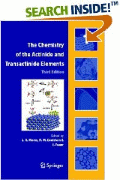
The Chemistry of the Actinide and Transactinide Elements

The Chemistry of the Actinide and Transactinide Elements is a contemporary and definitive compilation of chemical properties of all of the actinide elements, especially of the technologically important elements uranium and plutonium, as well as the transactinide elements. In addition to the comprehensive treatment of the chemical properties of each element, ion, and compound from atomic number 89 (actinium) through to 109 (meitnerium), this multi-volume work has specialized and definitive chapters on electronic theory, optical and laser fluorescence spectroscopy, X-ray absorption spectroscopy, organoactinide chemistry, thermodynamics, magnetic properties, the metals, coordination chemistry, separations, and trace analysis. Several chapters deal with environmental science, safe handling, and biological interactions of the actinide elements.

The Editors invited teams of authors, who are active practitioners and recognized experts in their specialty, to write each chapter and have endeavoured to provide a balanced and insightful treatment of these fascinating elements at the frontier of the periodic table. Because the field has expanded with new spectroscopic techniques and environmental focus, the work encompasses five volumes, each of which groups chapters on related topics. All chapters represent the current state of research in the chemistry of these elements and related fields.

Springer; 2007


Buchempfehlung

Jeremy Bernstein

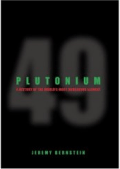
Plutonium
A History of the World's Most Dangerous Element

When plutonium was first manufactured at Berkeley in the spring of 1941, there was so little of it that it was not visible to the naked eye. It took a year to accumulate enough so that one could actually see it. Now there is so much of it that we do not know what to do to get rid of it. We have created a monster. The history of plutonium is as strange as the element itself. When scientists began looking for it, they did so simply in the spirit of inquiry, not certain whether there were still spots to fill on the periodic table. But the discovery of fission made it clear that this still-hypothetical element would be more than just a scientific curiosity - it could be a powerful nuclear weapon. As it turned out, it is good for almost nothing else. Plutonium's nuclear potential put it at the heart of the World War II arms race - the Russians found out about it through espionage, the Germans through independent research. Everybody wanted some. Now, nearly everyone has some - the United States alone has about 47 metric tons - but it has almost no uses besides warmongering. How did the product of scientific curiosity become such a dangerous burden? In his new history of this complex and dangerous element, noted physicist Jeremy Bernstein describes the steps that were taken to transform plutonium from a laboratory novelty into the nuclear weapon that destroyed Nagasaki. This is the first book to weave together the many strands of plutonium's story, explaining not only the science but the people involved.

Joseph Henry Press; 2007


Internetchemistry ChemLin © 1996 - 2011 A. J.